Showing posts with label religion. Show all posts

Monday, 12 April 2010

By lamplight

My love affair with all things Polish began in 2005, on a university choir tour to Kraków. Actually it was around the beginning of April 2005. The weekend after Easter. I wouldn't normally remember the date of a student trip, only this one was a little different, and not just because we brought winter vomiting flu to Luton airport (that, I feel, is a story for another time).
While we were in Kraków, at the end of March 2005, an elderly Polish gentleman (whose parents are buried in the Rakowicki cemetary in Kraków) lay dying in hospital. This elderly Polish gentleman was also known as Pope John Paul II, and, while we were enjoying the bright spring sunshine in the Planty, all of Poland (or at least all of Kraków) was out in the streets keeping watch for him and lighting candles. There are a lot of things about Polish Catholicism that make me uncomfortable, but one thing that I find striking in a positive way is its emotional side. That week in spring 2005, I and several other of the choir's excitable Catholics (and non-Catholics) went to kneel in Kościół Mariacki at one o'clock in the morning, stood outside what I now know to be the famous window on ul. Franciszkańska, lit candles and held hands with Polish strangers in the middle of the night and listened to them singing with tears streaming down their faces.

I was enchanted by a people that would go out on the streets to pay their respects to a man they may never have met, but who none the less was a son of their city. Leaving aside a budding fascination (or at least the sense of a challenge) with the language, my lasting impression was of a beautiful city flooded with cool, sharp sunshine and, by night, of people keeping watch and praying in the street.

Strangely - and possibly hypocritically - I feel cynical about patriotism and public displays of emotion in the UK, while in Poland I find it moving.

On the eve of All Saint's Day in 2007, I visited the Rakowicki cemetery and saw the lamps crowding the memorials and lighting up the darkness of the graveyard. I learnt that even empty plots are sometimes given lamps because no grave should be left out and it's a collective responsibility to make sure that no-one is forgotten.
When I was home for Easter last weekend, my Mum told me that she went to look for her father's grave and was upset that she couldn't find it: more plots had been added and the landscape had changed. Maybe we just have other ways to remember people and to pay our respects. Maybe not. I would like there to be lamps though.

By Saturday afternoon there were already flowers and candles outside the Polish Embassy. When I came back later in the evening, lamps were burning and there was a crowd of people standing outside keeping vigil. More flowers were there today.
Politically I was not a big fan of Kaczyński but no-one deserves to go like this; a lot of people died in the plane crash and it's especially awful that among them were representatives of the Katyń families, who have already suffered more than enough.
Incidentally, there are books of condolence at the Embassy if you live in Brussels and want to pay your respects. The doors are open from 9am until 5pm, until Saturday.


Not a great photo because I felt a little disrespectful taking pictures, but Polish mourners were (very discreetly) snapping away as well so I thought it was probably ok.

Monday, 5 April 2010

Why I am such a rubbish blogger at the moment

Many things. The last post that I wrote - and have not yet published - was about being attacked in the town centre last Friday, and I decided that it was too angry a post to actually publish. I am toning it down, but I want it out there so that other ex-pats are aware that the Belgian police are not necessarily on your side.

I'm in Sevenoaks at the moment and I don't use the computer as much here, mostly because there are Real People to talk to, dogs to walk, etc.

Things (in no particular order)

Easter - Easter at home is all about daffodils and roast dinners and going to church a lot. I don't attend church in Brussels: there's something about francophone Catholicism that I find hugely uninspiring. Probably the fact that people go in, listen and stare with glazed eyes for an hour, take Communion and then flee the scene. There is no participation, no sense of connection or enthusiasm and worst of all No Music, apart from the usual nasal chanter leading responses that no-one joins in.
On the other hand, I am loath to go to one of those suspiciously friendly ex-pat churches, where well-meaning but overbearing parishioners zoom in on unsuspecting newcomers like hawks and before you know it you are on the coffee rota and attending evening songs of praise and signed up to goodness knows what else.
I am just starting my third decade on the planet, I have grey hairs (only two) and lines on my forehead and am increasingly wondering what it will be like to die. If I am going to be religious, I need it to engage me on an intellectual level, because at the moment I'm afraid Dawkins and the like have a pretty strong rational argument.
In the church that my parents attend, there are intelligent, professional people, whom I admire, and who have very strong beliefs, and I want to know where it all comes from. What do they know that I don't?

Katyń: I rented the DVD and finally saw this film, monopolising my parents' television and lounge for a good couple of hours (by the time I'd got 36 minutes into the Andrzej Wajda interview at the end I think they had had more or less enough).
I'm not a film critic and I tend to get emotionally involved in films, rather than making a detached analysis. I do however watch films set during this period with a great deal of caution, knowing how easy it is to be carried along and to become incensed about an issue which is not my battle.
One thing I will say is that the English subtitles on my rented DVD were appalling. Obviously my Polish isn't good enough for me to be able to catch everything on a film soundtrack (nor for that matter are my French and Italian, sometimes, if the accent is difficult, the dialogue fast and the background music loud). So I wasn't checking the translation. In any case, there's a fair amount of Russian and German dialogue in the film. And I'm not a trained subtitler, although I'm aware that there are certain time and space restrictions.
But: every time I looked down, the quality of the English was poor. It had clearly never even been checked by a native speaker. Subtitles are a way for foreigners, in this case English speakers, to access a film and a story that they would never otherwise have heard. What a betrayal of Wajda and of his subject matter to use such bad quality subtitling! Why, for the umpteenth time, is no-one prepared to pay for decent Polish to English translation?!

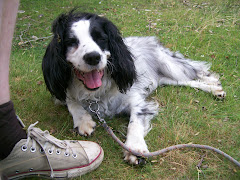
The Other Dog is very old and grumpy now and almost completely blind. He was diagnosed with diabetes some time last year and in the time it took to get it under control he lost his sight. He also has liver failure and is still not putting on weight, for no apparent reason. My parents have had him insured from the outset, which is lucky because the tests and consultations and overnight stays at the specialist vet's have already run to thousands of pounds. He seems perfectly happy, although he walks into cupboards a lot and occasionally trips over bumps if we forget to say 'step!'. He still eats and enjoys going for short walks and snarls at us if we tread on his tail. His ears prick up when you call him and he trots along with his tail in the air like a flag. My theory is that if he's still bright enough to try and raid the kitchen bin then he's far from ready to go yet. But I'm sad for all the people who have to put down pets which are still relatively healthy because they simply can't afford the vet's bills.

Things: my parents' house is full of things. Things they have collected over more than thirty years of marriage, things their grown-up children have left behind, things they have inherited from elderly relatives who have moved on in any sense. Some of the things are interesting: the tub chair my paternal grandmother used to sit in to have her hair set, a mysterious pastel portrait known only as 'Mrs Harford', boxes and boxes of old slides and photos. But all the interesting things are smothered in piles of linen and papers and old clothes and crumbling plastic bags full of ancient children's toys.
When somebody visits, they have to rearrange the things to make room for the extra person.

When I stay here, I feel as though I am suffocating under the weight of all the old things.

Monday, 26 October 2009

Tea

Before I left the UK, tea came in two kinds: Earl Grey (if you were trying to be posh) and Tetley (if you were trying not to be)*.
It normally came in bags, except when I was very very little (before my parents gave up on that sort of thing altogether) when there would always be a lot of soggy tea leaves in the plughole of the kitchen sink at breakfast time. Ideally it would be made in a pot, but then again any port in a storm.

If you asked for it without milk, you were considered a bit weird (even those who took it without sugar were living dangerously close to the edge).

Society was divided between those who put the milk in the cup first, and those who put it in afterwards. There are some highly valid and very scientific arguments for and against both stances, into which we will not go today.

Herbal tea was what Peter Rabbit was given as a punishment for breaking into Mr McGregor's garden.

Outside England tea is a different matter entirely.

It's actually ironic that we are considered to be the most tea-fussy nation in Europe, when British tea rituals are quite literally sloppy compared to those of - um let's think - the Poles.

For example, before leaving England, I never gave a second thought to tea brewing. You swirled the teabag around, gave it a bit of squeeze on the side of the cup and then flicked it into the bin (best done Dennis the Menace-style on the end of a teaspoon from the other side of someone else's kitchen).
What a fool I was. Now I know that you must drop the teabag (or tea leaf dongle thingy, or tea sock - don't ask, they look terrible) into a glass of boiling water, place the saucer delicately over the top and leave for five minutes. Five minutes, incidentally, is just enough time for the saucer to become very, very hot, and for you to burn your fingers.
Afterwards, you may add sugar, and/or a slice of lemon. You may drink it with milk, but only if you are pregnant or - apparently - an old-school Communist. In winter, the addition of raspberry syrup is compulsory. In the first language school I attended in Kraków, they never served it any other way. Requests for water were greeted with blank looks and confusion.

When you visit a friend, you will always be offered tea. And here the competitive streak kicks in.
- Thanks, what do you have?
you might innocently reply.
- Well... not much: English breakfast, Earl Grey, fruit tea, green tea, peppermint tea, Yogi Tea, Pu-Erh, Sencha, czarna porzeczka and something strange in a brown bag that came from that tea shop on Jozefa that closed recently - the one with the funny smell next to what used to be the Shisha place.

If you are sensible, you will pick English breakfast. Almost all of the others will be in leaf form, and then the ritual begins.
The safest way to brew leaf tea is in a pot, clearly. But, it can be done in a cup: various devices exist to assist this process.
Firstly, the springy thingy.
This looks like two tea strainers clasped together in a sort of scissors arrangement.
In theory the mechanics is good, but beware: having sprinkled that last gram of dry tea into one half of the strainer, take care not to snap the pincers shut Too Fast: tea leaves will be sprayed everywhere and will probably end up floating on the surface of your tanninate beverage.

Secondly, the Tea Sock.
Like the springy thingy, this looks fairly innocent when it's new and clean: it's a sort of long sack, in natural cotton, like the end of a pair of tights. Warning! After two or three uses, the Tea Sock will be stained an appetizing shade of tannin brown, looking for all the world like a very mangy pair of saggy cotton Y-fronts.

The worst part of it all is that eventually you start to feel ashamed of your own pathetic tea shelf offering. You find yourself unable to resist the siren waft of the tea merchant: that fragrance draws you in, you begin to collect teas too. My parents despair because their larder is filled with Ginger Spice digestive tea, Twinings Peppermint and Camomile (tea shelf staples), Taylor and Harrogate Green tea and something weird we found at the back of Grandma's kitchen cupboard.

However, unless you're buying it in loose leaves by the ounce and taking it home in a brown paper bag, you're not doing it properly. I'm safe for the moment. But how long will it last?

to be continued...


*come to think of it, this actually sums up British class attitudes pretty well.

Sunday, 17 May 2009

Wycieczka na Wschód

Elements of a perfect school field trip:

- Starts at very-early-o'clock in the morning: lots of students standing outside school eating pretend croissants by 7 Days. Several people nearly get left behind.
- Although our teacher instructs us very emphatically to stay awake and look out of the window, we all fall asleep almost as soon as the coach starts moving.
- There is approximately one public toilet in the whole of Małopolska.
- Someone spills orange juice on the coach and the driver goes ballistic, almost abandoning us in Biecz (wherever that is).
- It is fun to climb up bell-towers in wooden churches!
- It is not fun to eat only ice-cream all day and pee in a bush.
- Polish people who do guided tours of churches speak veryfastindeed.
- Predictably, when you visit a historic church, the caretaker will try to encourage you to get married there.
- Trying to find a place to eat in a group of eleven will take forever. Add an extra half-hour to forever for each additional person.

Fotki:


A Big Polish house, like what they build in the country. Looks as though it only has three levels instead of the customary four.


Inside the synagogue at Bobowa, former centre of Hassidic Jewish life, now a place of pilgrimage.


Wooden church of St Michael the Archangel in Binarowa, dating from about 1500. Gosh that's old.


The paintings inside date from the 16th century


Vestry painting


Painted interior of the church


Cerkiew (Orthodox church) in Kwiaton, former settlement of the Lemkos or Rusyns (cue lots of angry comments from Real Łemkowie because I got it wrong again). Slavic cultural history is cool.


Inside the church - which smelt strongly of Ronseal wood preservative. Now re-consecrated as a Catholic church, since the original Eastern Orthodox congregations have long since moved on.


An Orthodox lapidarium - no actual graves, just the tombstones, which were rescued and restored. The Łemkowie and their families are long gone and the gravestones were rescued from various centres of Łemko or Rusyn culture and are currently undergoing restoration. The inscriptions are in Cyrillic and the language is apparently a cross between Ukrainian and Polish. It's fascinating. I wonder who they were, where they went, and where their descendants are now...


Friday, 10 April 2009

Good Friday

There's a sense of quiet drama about Good Friday, even in the context of English - rather than Polish - Catholicism. The inside of the church is stripped bare: no flowers, no altar cloth, no wall hangings - even the carpets are torn up and rolled away out of site.
The atmosphere is one of deep sorrow. Lighting is kept to a bare minimum and music is provided only to pick out the supporting chants and responses. Any statues are shrouded in purple cloth. Banners and even votive light stands are turned to face the wall, as though hiding their faces.

Devoid of inspiring images, music and lighting, in an empty, whitewashed building, human beings search for a sense of the divine - for an answer from the blankness: why have you forsaken us?

Monday, 9 March 2009

Picture thief

Hurrying back to school down Grodzka in the grey afternoon chill, I was approached from the right by a shaven-headed young man in a green military jacket. Now, having lived near two major tram stops in Kraków, I've become adept at side-stepping those poor souls who have to stand in the rain every day handing out ulotki. However, this particular character was not in fact a slave to the publicity machine: rather, he was handing out small cards displaying pictures of the late Pope John Paul II.

Since it would have been rude to say no to The Pope, I took the card and hurried on before crew-cut guy had time to start his spiel.
Contrary to my expectations, my picture-purveying friend began to hurry after me, aggressively pushing another card towards me and muttering something that I couldn't quite catch.

It is my custom, when pursued by strange men in the street, to run.

(this may be why I don't have a boyfriend)

Crew-cut guy shouted in outrage and began to chase after me; I dashed across the street, picking up the pace, but he cornered me on the pavement beyond St Peter and St Pauls' church. By this time a few particles of reason had filtered through the fight or flight hormones, and I realised why the gentleman was pursuing me with such indignation.

The little prayer cards were actually for sale, and I had just run off with his merchandise.

Longing only to get away from the situation and the aggression of the picture seller, I flung the card back at him, accompanied by some distinctly unladylike phraseology, and fled the rest of the way back to the school (mercifully on a slight downhill slope).

Now you know.

I steal pictures of the Pope from Polish catholics.

Sunday, 6 July 2008

Sucré Coeur

In Swiss churches they give you brioche for communion!!

It's hard to feel Serious Reverence For The Almighty when all you can think about is how a dollop of apricot jam would go just nicely...

Sunday, 15 June 2008

Enlightenment

My brother, a gentle-looking chap, is often approached by enthusiastic young men of the Hare Krishna persuasion, and he has the pile of books to prove it. However, it's not always easy to start a conversation with a stranger:

Hare Krishna guy to my brother: 'That's a nice beard. Did you grow it yourself?'
Bro: 'No, actually it's my sister's: I just borrow it at the weekend.'

HK: Here. Take a copy of our book.
Bro: Oh thanks, but I'm actually reading something else at the moment.
HK: Oh really? What are you reading?
Bro: A book called 'The Plague'. It's by Albert Camus.

HK, appalled: That goes against everything we believe in!

I rather suspect that telling the Hare Krishnas you like to read Camus is akin to telling the Mothers' Union that you like to paint yourself in pig's blood and make animal sacrifices. Although I'm sure lots of enlightened HKs will be able to put me straight.

In any case, the guy disappeared shortly after. My brother didn't get a copy of the book.